
Practical Benefits of Wall-Hung Toilets for Your Bathroom
Share
Practical Benefits of Wall-Hung Toilets for Your Bathroom
A wall-hung toilet mounts the bowl off the floor and hides the tank inside the wall. It is the single biggest visual change you can make to a small bathroom, and it makes the floor genuinely easy to clean for the first time. At Eunoia we carry a curated selection of wall-hung toilets alongside the in-wall tanks and carriers they mount to.
The space-saving advantage
Removing the floor-mounted base frees up visible floor area, which is why these are so common in powder rooms and condos. The carrier also lets you set the bowl height during installation — you are not locked to a standard rim height the way you are with a floor toilet. On a floor-mounted toilet that decision is made for you at the factory, which is why standard versus universal height matters so much there.
Aesthetic versatility
A wall-hung bowl reads as a single clean form with nothing running to the floor. Our selection spans TOTO and Duravit, from minimalist rimless shapes to more traditional profiles.
The three parts you are actually buying
This is where a wall-hung purchase differs from any other toilet. You need three things, and they are usually bought separately:
- The bowl — from wall-hung toilets.
- The in-wall tank and carrier — the steel frame and concealed cistern that carry the load. See in-wall tanks & carriers.
- The actuator plate — the flush button on the wall, and the only part of the system you see. See actuator plates.
Check that the carrier fits your wall depth before ordering — a standard 2x4 stud wall and a 2x6 wall take different frames.
Carrier brands we stock
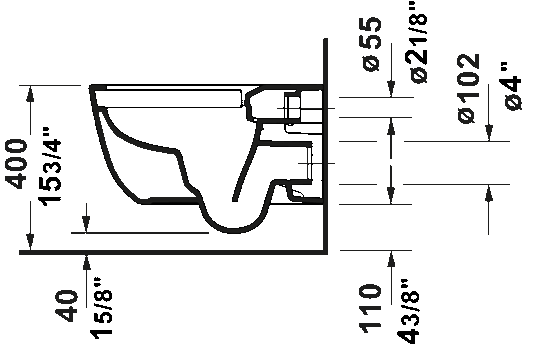
Our in-wall carriers come from Geberit, Duravit, Grohe and TOTO. Geberit effectively invented the category and remains the reference point; the others build to the same principle. Whichever you choose, pair the carrier and bowl from the same system where possible — mounting bolt spacing and waste outlet position are not universal.
If you are leaning towards a Duravit bowl, its HygieneGlaze finish is worth understanding first.
Installation considerations
This is not a swap-in-an-afternoon job. The wall has to be opened up, the carrier bolted to the floor and studs, and the whole thing closed and finished before the bowl goes on. A properly installed carrier is rated to well over the weight of any user — the load goes into the frame and floor, not the drywall — but it has to be installed correctly to get there. Plan it as part of a renovation, not as a standalone replacement.
Send us your wall construction and rough-in details and we will confirm which carrier suits before you order.
Maintenance and cleaning
With nothing meeting the floor, the mop goes straight underneath. There is no base to trap dirt and no crevice behind the pedestal. Servicing is done through the actuator plate opening — the fill valve and flush valve are reachable without opening the wall again.
Cost
The up-front cost is higher, because you are buying three components and paying for a more involved installation. What you get back is floor space, a cleaner-looking room, easier cleaning, and — on the dual-flush systems most carriers use — lower water use over the life of the fixture.
Is it right for your bathroom?
Wall-hung is worth it when you are already opening the wall, or when floor space and the look of the room matter more than installation simplicity. If the wall is staying shut, a one-piece or two-piece toilet is the sensible choice — our guide to one-piece vs. two-piece compares them, and you will need your rough-in measurement either way. A smart toilet gets you the bidet functions whichever shape you choose.
Browse wall-hung toilets or all toilets to compare.