Collection: Shower Valves & Parts

-
Kohler Rite-Temp Test Cap for K-8300 Series Valve Bodies - K-10351-NA
Vendor:KohlerRegular price $15.00Regular priceUnit price per$20.00Sale price $15.00Sale -
Kohler Rite-Temp Deep Rough-In Kit - K-10350-NA
Vendor:KohlerRegular price $95.25Regular priceUnit price per$127.00Sale price $95.25Sale -

Delta MultiChoice Universal Rough-In Valve with Integrated Diverter - R22000-WS Series
Vendor:DeltaRegular price From $215.46Regular priceUnit price per$307.80Sale price From $215.46SaleReady to Ship -
Delta SelectChoice Universal Tub / Shower Rough - Universal Inlets / Outlets - R23000-WS
Vendor:DeltaRegular price $198.80Regular priceUnit price per$284.00Sale price $198.80Sale -
Rohl Wall Mount Tub Spout Rough-in Valve - 16003224
Vendor:RohlRegular price $128.10Regular priceUnit price per$183.00Sale price $128.10Sale -
Rohl Eclissi Wall Mount Rough-In Valve - 300073RHL00
Vendor:RohlRegular price $219.10Regular priceUnit price per$313.00Sale price $219.10Sale -
Rohl 1/2" Valves Rough-In For Wall Mount Cross Set - A5039X
Vendor:RohlRegular price $219.80Regular priceUnit price per$314.00Sale price $219.80Sale -
Rohl 1/2" Valves Rough-In For Wall Mount Lever Set - A5039L
Vendor:RohlRegular price $219.80Regular priceUnit price per$314.00Sale price $219.80Sale -
Vogt Rough For Mond Wall Mount Tub Filler - VE.2210
Vendor:VogtRegular price $457.50Regular priceUnit price per$610.00Sale price $457.50Sale -
Vogt Rough For Zehn Floor Mount Tub Filler - VE.2100
Vendor:VogtRegular price $341.25Regular priceUnit price per$455.00Sale price $341.25Sale -
Baril 3-Way Pressure-Balanced Rough-In (PEX) - RVA-9191-P0
Vendor:BarilRegular price $310.80Regular priceUnit price per$444.00Sale price $310.80Sale -
Baril Single Lever Wall-Mounted Lavatory Rough, ROU-8147-04-B
Vendor:BarilRegular price $197.40Regular priceUnit price per$282.00Sale price $197.40Sale -
Baril Rough-In For Floor-Mounted Tub Filler, Standard Floor Installations - ROU-110W-00-B
Vendor:BarilRegular price $136.50Regular priceUnit price per$195.00Sale price $136.50Sale -
Baril Rough-In For Floor-Mounted Tub Filler, Concrete/Subfloor Installations - ROU-110C-00-B
Vendor:BarilRegular price $157.50Regular priceUnit price per$225.00Sale price $157.50Sale -
Delta Flexible Rough-In For 3-Hole Two-Handle Roman Tub Faucet PEX Crimp - R2707-PX
Vendor:DeltaRegular price $183.02Regular priceUnit price per$261.45Sale price $183.02Sale -

Delta Flexible Rough-In For 3-Hole Two-Handle Roman Tub Faucet - R2707
Vendor:DeltaRegular price $158.06Regular priceUnit price per$225.80Sale price $158.06SaleReady to Ship -

Delta MultiChoice Universal Tub / Shower Rough - Universal Inlets / Outlets - R10000-UN
Vendor:DeltaRegular price $56.84Regular priceUnit price per$81.20Sale price $56.84SaleReady to Ship -
Delta MultiChoice Tub / Shower Rough - IPS Inlets / Outlets - R10000-IP
Vendor:DeltaRegular price $56.84Regular priceUnit price per$81.20Sale price $56.84Sale -
Delta MultiChoice Tub / Shower Rough - IPS Inlets / Outlets With Stops - R10000-IPWS
Vendor:DeltaRegular price $79.52Regular priceUnit price per$113.60Sale price $79.52Sale -

Delta 3 and 6-Setting Diverter Rough-In Valve - R11000
Vendor:DeltaRegular price $129.33Regular priceUnit price per$184.75Sale price $129.33SaleReady to Ship -
Vogt 3/4" 3-Way Diverter Valve - VE.DR.30
Vendor:VogtRegular price $141.75Regular priceUnit price per$189.00Sale price $141.75Sale -
Vogt 3/4" 2-Way Diverter Valve - VE.DR.20
Vendor:VogtRegular price $131.25Regular priceUnit price per$175.00Sale price $131.25Sale -
Vogt 3/4" Volume Control Valve - VE.SV.01
Vendor:VogtRegular price $116.25Regular priceUnit price per$155.00Sale price $116.25Sale -
Vogt 3/4" High-Flow Thermostatic Valve With 2 Integrated Volume Controls - VE.250
Vendor:VogtRegular price $603.75Regular priceUnit price per$805.00Sale price $603.75Sale




About this collection
Shower Rough-In Valves & Parts
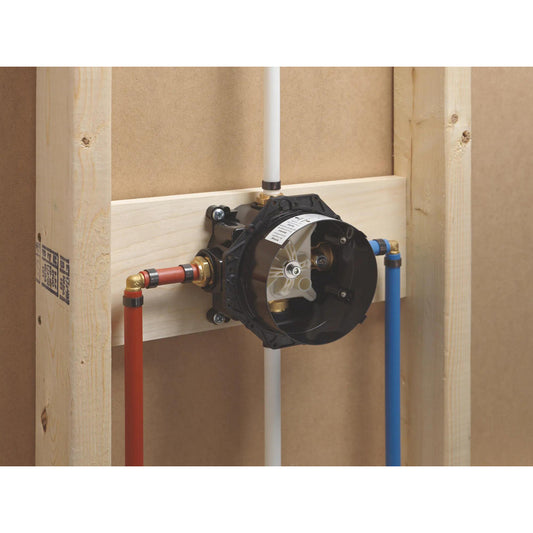
The valve is the half of the shower nobody sees and everybody depends on. It goes into the wall before the tile, it controls temperature and flow, and it determines which trim you can ever fit afterwards. Eunoia carries 135 rough-in valves and related parts from Brizo, Baril, Riobel, Delta, Rohl, Vogt, Grohe and Perrin & Rowe, covering pressure-balance, thermostatic and combined valves.
The rule that governs this whole category
The valve and the trim must be the same brand, and usually the same series. A rough-in valve is a manufacturer-specific casting with its own cartridge, port layout and mounting depth. A Riobel trim will not fit a Delta valve. Frequently, a current trim will not fit that same brand's previous-generation valve either.
This is why buying the valve is a decision about the next twenty years, not just this renovation. Choose the brand you want to live with, then buy both halves from it.
Valve types
- Pressure-balance — holds the hot/cold ratio steady when pressure changes elsewhere in the house. Protects against scalding. One outlet, one handle. The standard choice for a simple shower.
- Thermostatic — holds an actual set temperature and supports several outlets at once. Necessary for a rain head plus a handheld plus body sprays.
- Thermostatic/pressure-balance combined — separate temperature and volume controls. The most common choice in a well-specified bathroom.
- Diverter and volume control valves — a diverter switches flow between outlets one at a time; a volume control runs two at once and sets each independently. Decide which you need before the wall closes.
- Tub filler valves — floor-mount, wall-mount and deck-mount rough-ins, each specific to how the filler is mounted.
- Wall-mount lavatory valves — the in-wall half of a wall-mounted bathroom faucet.
Three things to get right at rough-in
- Depth. Valves have a set mounting range relative to the finished wall — tile, backer and thinset included, not the studs. Set too deep and the trim will not reach; too shallow and it stands proud.
- Orientation. Most valves are marked for up. Fitting one rotated will invert hot and cold or leave the trim crooked.
- Outlet count. A two-outlet valve cannot later feed three. Adding a body spray afterwards means opening the wall.
Many valves ship with a plaster guard — leave it on through tiling. It protects the cartridge and sets the finished depth for you.
Replacing a valve you did not choose
If you are trying to identify an existing valve, photograph the trim plate and, if you can reach it, the back of the escutcheon and the cartridge. Send it to us. In many cases we can match a trim to the valve you already have without opening the wall — see Shower Components & Trim Kits.
Buying from Eunoia
We are an authorized dealer for every brand on this page, which is what makes older valve cartridges obtainable at all — and it is the reason to buy a valve from one. Over 3,000 of our products ship free anywhere in Canada; look for the free-shipping badge on the product page. Everything ships free within Ontario, and any order over $3,000 ships free Canada-wide.
Also see: Shower Kits · Shower Faucets & Trims · Components & Trim Kits · Installation Systems & Parts
Frequently asked questions
What is a rough-in valve?
The part of the shower that goes inside the wall before tiling. It controls temperature and flow; the trim you see afterwards is fitted to it.
Can I use any trim with any valve?
No. Trim is matched to a specific valve body from the same manufacturer, and often to a specific generation. Mixing brands does not work.
How do I identify the valve already in my wall?
Photograph the trim plate, and the back of the escutcheon and the cartridge if you can reach them. Send it to us and we will usually identify it — which means a new trim without opening the wall.
Thermostatic or pressure-balance?
Pressure-balance is sufficient for a single shower head. Thermostatic is needed to run several outlets at once and holds an exact set temperature.
What is a plaster guard?
The plastic cover shipped on many valves. Leave it in place through tiling — it protects the cartridge and sets the correct depth relative to the finished wall.
More Ways to Shop
-

Shower Kits
Shower Kits & Complete Systems A shower kit is the whole shower...
-

Shower Faucets & Trims
Shower Faucets and Fixtures – Available Across Canada Upgrade your bathroom with...
-

Shower Faucet Parts & Trim Kits
Shower Faucet Parts & Trim Kits This is the collection you need...
-

Bathtub Faucets
Bathtub Faucets & Tub Fillers A tub faucet has one job most...
-

Installation Systems & Parts
The concealed side of a bathroom: Geberit and Duravit in-wall tank systems...
-

Faucet Parts & Hardware
Replacement parts for bathroom, kitchen and shower faucets — ceramic and thermostatic...